
Cyber Resilience for SMBs: Reduce Risk Without Enterprise Bloat!
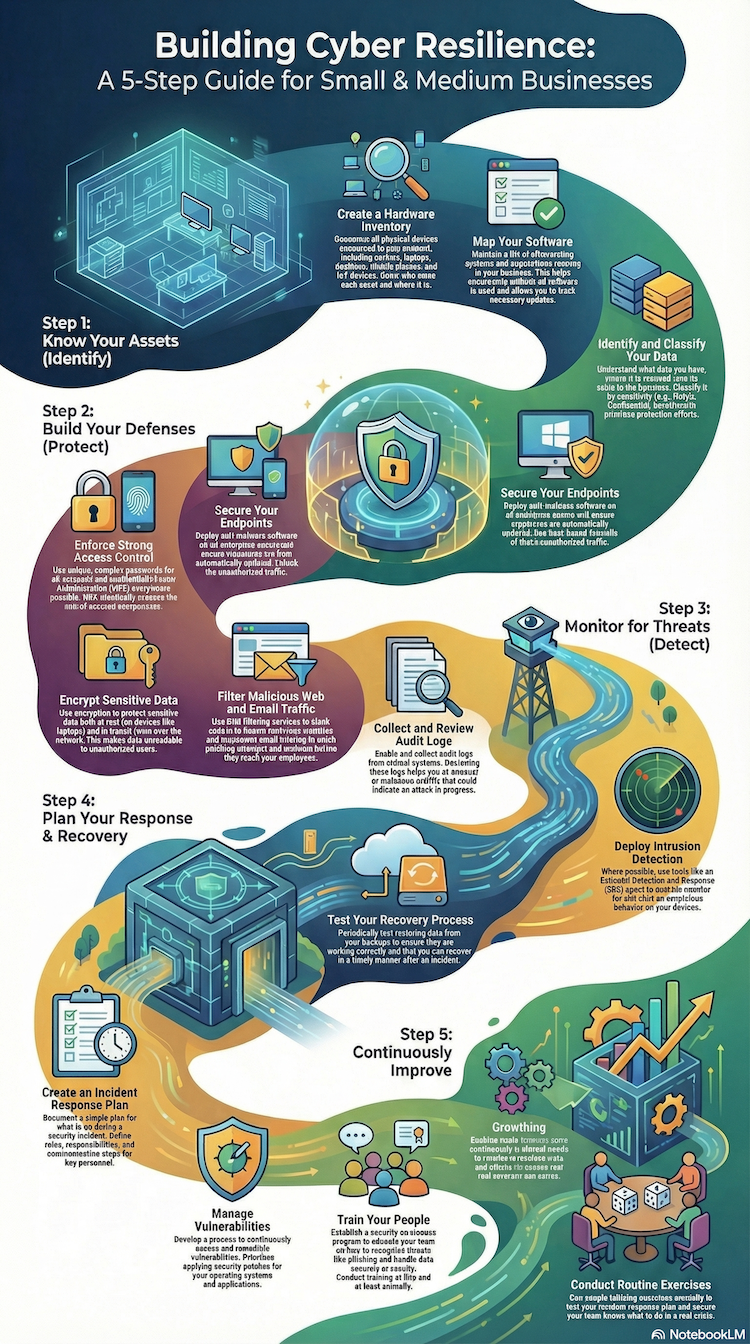
Moving beyond cybersecurity only

Cybersecurity isn’t just tools—it’s the ability to keep operating through disruption. Cyber resilience focuses on outcomes: limiting damage, restoring quickly, and proving control to customers, regulators, and insurers.


What cyber resilience means (bullets)

  • Prevent the most common failure modes (phishing, credential abuse, ransomware)

  • Detect fast enough to stop spread and data loss

  • Respond with a repeatable plan (not improvisation)

  • Recover with tested backups and clear responsibilities

  • Prove progress with measurable evidence


Why it matters in 2025–2026

Attackers are faster, automation is everywhere, and insurers/compliance pressure is rising. Resilience is the difference between “an incident” and “a business-ending event.”


NIST CSF v2 in plain language

NIST CSF v2 is a way to organize resilience outcomes into a practical roadmap. It helps you decide what to do first and how to measure progress over time.


ROI (make it practical)

Resilience lowers:

  • downtime cost

  • incident response spend

  • legal/forensics costs

  • repeat incidents

  • insurance friction (and often premium pressure)


https://halcyoncyber.works/wp-content/uploads/2025/12/cyber-res001-1.png

Frequently Asked Questions (FAQ)

Got a question? We’ve likely answered it here.

  • Q1: What does “cyber resilience” mean for an SMB in Northern Virginia/DMV?
  • Q2: How is cyber resilience different from “cybersecurity”?
  • Q3: What are the fastest resilience improvements most SMBs can make?
  • Q4: How does NIST CSF v2 help improve resilience?
  • Q5: Is this a compliance framework or a practical plan?
  • Q6: What’s the best first step if we’re not sure where we stand?
Q1: What does “cyber resilience” mean for an SMB in Northern Virginia/DMV?

A: It means your business can keep operating through disruption—phishing, ransomware, account takeover, vendor compromise—by preventing common failures, detecting quickly, responding consistently, and recovering fast.

Q2: How is cyber resilience different from “cybersecurity”?

A: Cybersecurity often focuses on tools and protection. Cyber resilience focuses on outcomes: fewer successful incidents, shorter downtime, faster containment, and evidence you can show to leadership, customers, or insurers.

Q3: What are the fastest resilience improvements most SMBs can make?

A: MFA everywhere, strong email security, endpoint visibility (EDR/XDR), tested backups, least-privilege access, and a basic incident response plan with clear roles.

Q4: How does NIST CSF v2 help improve resilience?

A: NIST CSF v2 provides a structured way to prioritize improvements and measure progress over time. It turns “security chaos” into a roadmap aligned to business risk and budget.

Q5: Is this a compliance framework or a practical plan?

A: It can support both. We use it as a practical plan first—then translate progress into evidence that also supports compliance and insurance readiness.

Q6: What’s the best first step if we’re not sure where we stand?

A: Start with the NIST CSF v2 Quick Check to get a baseline and prioritized next steps, or book a consult if you want guidance immediately.


Ready for a budget-aligned cyber resilience plan?

Start with a quick benchmark or book a free online working session.

Book a FREE 30-min Consult
Take the CSF Quick Check
Take the CDM Quick Check